The Josephson effect is the phenomenon of supercurrent, a current that flows continuously without any voltage applied, across a device known as a Josephson junction (JJ), which consists of two or more superconductors coupled by a weak link. The weak link can consist of a thin insulating barrier (known as a superconductor–insulator–superconductor junction, or S-I-S), a short section of non-superconducting metal (S-N-S), or a physical constriction that weakens the superconductivity at the point of contact (S-s-S).
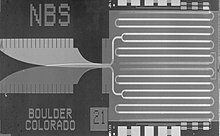
The Josephson effect is an example of a macroscopic quantum phenomenon. It is named after the British physicist Brian David Josephson, who predicted in 1962 the mathematical relationships for the current and voltage across the weak link.[1][2] The DC Josephson effect had been seen in experiments prior to 1962,[3] but had been attributed to "super-shorts" or breaches in the insulating barrier leading to the direct conduction of electrons between the superconductors. The first paper to claim the discovery of Josephson's effect, and to make the requisite experimental checks, was that of Philip Anderson and John Rowell.[4] These authors were awarded patents on the effects that were never enforced, but never challenged.
Before Josephson's prediction, it was only known that normal (i.e. non-superconducting) electrons can flow through an insulating barrier, by means of quantum tunneling. Josephson was the first to predict the tunneling of superconducting Cooper pairs. For this work, Josephson received the Nobel Prize in Physics in 1973.[5] Josephson junctions have important applications in quantum-mechanical circuits, such as SQUIDs, superconducting qubits, and RSFQ digital electronics. The NIST standard for one volt is achieved by an array of 20,208 Josephson junctions in series.[6]
Applications

Types of Josephson junction include the φ Josephson junction (of which π Josephson junction is a special example), long Josephson junction, and superconducting tunnel junction. A "Dayem bridge" is a thin-film variant of the Josephson junction in which the weak link consists of a superconducting wire with dimensions on the scale of a few micrometres or less.[7][8] The Josephson junction count of a device is used as a benchmark for its complexity. The Josephson effect has found wide usage, for example in the following areas.
SQUIDs, or superconducting quantum interference devices, are very sensitive magnetometers that operate via the Josephson effect. They are widely used in science and engineering.
In precision metrology, the Josephson effect provides an exactly reproducible conversion between frequency and voltage. Since the frequency is already defined precisely and practically by the caesium standard, the Josephson effect is used, for most practical purposes, to give the standard representation of a volt, the Josephson voltage standard.
Single-electron transistors are often constructed of superconducting materials, allowing use to be made of the Josephson effect to achieve novel effects. The resulting device is called a "superconducting single-electron transistor".[9]
The Josephson effect is also used for the most precise measurements of elementary charge in terms of the Josephson constant and von Klitzing constant which is related to the quantum Hall effect.
RSFQ digital electronics is based on shunted Josephson junctions. In this case, the junction switching event is associated to the emission of one magnetic flux quantum 
Josephson junctions are integral in superconducting quantum computing as qubits such as in a flux qubit or others schemes where the phase and charge act as the conjugate variables.[10]
Superconducting tunnel junction detectors (STJs) may become a viable replacement for CCDs (charge-coupled devices) for use in astronomy and astrophysics in a few years. These devices are effective across a wide spectrum from ultraviolet to infrared, and also in x-rays. The technology has been tried out on the William Herschel Telescope in the SCAM instrument.
Quiterons and similar superconducting switching devices.
Josephson effect has also been observed in superfluid helium quantum interference devices (SHeQUIDs), the superfluid helium analog of a dc-SQUID.[11]
The Josephson equations

A diagram of a single Josephson junction is shown at right. Assume that superconductor A has Ginzburg–Landau order parameter 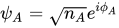
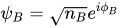



where the constant 

and therefore the Schrödinger equation gives:

The phase difference of Ginzburg-Landau order parameters across the junction is called the Josephson phase:
.
The Schrödinger equation can therefore be rewritten as:

and its complex conjugate equation is:

Add the two conjugate equations together to eliminate 

Since 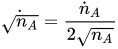
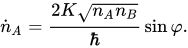
Now, subtract the two conjugate equations to eliminate 

which gives:
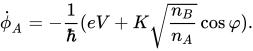
Similarly, for superconductor B we can derive that:

Noting that the evolution of Josephson phase is 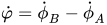


(1st Josephson relation, or weak-link current-phase relation)
(2nd Josephson relation, or superconducting phase evolution equation)
where 


The Josephson constant is defined as:

and its inverse is the magnetic flux quantum:
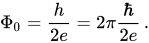
The superconducting phase evolution equation can be reexpressed as:
![{\displaystyle {\frac {\partial \varphi }{\partial t}}=2\pi [K_{J}V(t)]={\frac {2\pi }{\Phi _{0}}}V(t)\,.}](https://wikimedia.org/api/rest_v1/media/math/render/svg/c6a4d19b714169b822a4cda059cb835a84303f25)
If we define:

then the voltage across the junction is:
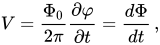
which is very similar to Faraday's law of induction. But note that this voltage does not come from magnetic energy, since there is no magnetic field in the superconductors; Instead, this voltage comes from the kinetic energy of the carriers (i.e. the Cooper pairs). This phenomenon is also known as kinetic inductance.
Three main effects
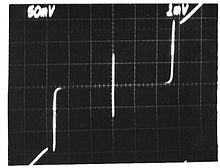
 represents the DC Josephson effect, while the current at large values of
  is due to the finite value of the superconductor bandgap and not reproduced by the above equations.
There are three main effects predicted by Josephson that follow directly from the Josephson equations:
The DC Josephson effect
The DC Josephson effect is a direct current crossing the insulator in the absence of any external electromagnetic field, owing to tunneling. This DC Josephson current is proportional to the sine of the Josephson phase (phase difference across the insulator, which stays constant over time), and may take values between 
The AC Josephson effect
With a fixed voltage 

The inverse AC Josephson effect
Microwave radiation of a single (angular) frequency 


The DC components are:

This means a Josephson junction can act like a perfect frequency-to-voltage converter,[15] which is the theoretical basis for the Josephson voltage standard.
Josephson inductance
When the current and Josephson phase varies over time, the voltage drop across the junction will also vary accordingly; As shown in derivation below, the Josephson relations determine that this behavior can be modeled by a kinetic inductance named Josephson Inductance.[16]
Rewrite the Josephson relations as:
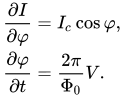
Now, apply the chain rule to calculate the time derivative of the current:

Rearrange the above result in the form of the current–voltage characteristic of an inductor:

This gives the expression for the kinetic inductance as a function of the Josephson Phase:
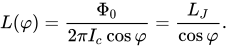
Here, 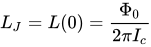
Note that although the kinetic behavior of the Josephson junction is similar to that of an inductor, there is no associated magnetic field. This behaviour is derived from the kinetic energy of the charge carriers, instead of the energy in a magnetic field.
Josephson energy
Based on the similarity of the Josephson junction to a non-linear inductor, the energy stored in a Josephson junction when a supercurrent flows through it can be calculated.[17]
The supercurrent flowing through the junction is related to the Josephson phase by the current-phase relation (CPR):

The superconducting phase evolution equation is analogous to Faraday's law:
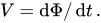
Assume that at time 



This shows that the change of energy in the Josephson junction depends only on the initial and final state of the junction and not the path. Therefore the energy stored in a Josephson junction is a state function, which can be defined as:

Here 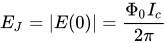


Again, note that a non-linear magnetic coil inductor accumulates potential energy in its magnetic field when a current passes through it; However, in the case of Josephson junction, no magnetic field is created by a supercurrent — the stored energy comes from the kinetic energy of the charge carriers instead.
The RCSJ model
The Resistively Capacitance Shunted Junction (RCSJ) model,[18][19] or simply shunted junction model, includes the effect of AC impedance of an actual Josephson junction on top of the two basic Josephson relations stated above.
As per Thévenin's theorem,[20] the AC impedance of the junction can be represented by a capacitor and a shunt resistor, both parallel[21] to the ideal Josephson Junction. The complete expression for the current drive 

where the first term is displacement current with 

Josephson penetration depth
The Josephson penetration depth characterizes the typical length on which an externally applied magnetic field penetrates into the long Josephson junction. It is usually denoted as 
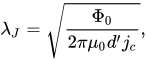
where 



where 


| This article uses material from the Wikipedia article Metasyntactic variable, which is released under the Creative Commons Attribution-ShareAlike 3.0 Unported License. |