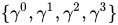
In mathematical physics, the gamma matrices, , also known as the Dirac matrices, are a set of conventional matrices with specific anticommutation relations that ensure they generate a matrix representation of the Clifford algebra Cℓ1,3(R). It is also possible to define higher-dimensional gamma matrices. When interpreted as the matrices of the action of a set of orthogonal basis vectors for contravariant vectors in Minkowski space, the column vectors on which the matrices act become a space of spinors, on which the Clifford algebra of spacetime acts. This in turn makes it possible to represent infinitesimal spatial rotations and Lorentz boosts. Spinors facilitate spacetime computations in general, and in particular are fundamental to the Dirac equation for relativistic spin-½ particles.
In Dirac representation, the four contravariant gamma matrices are
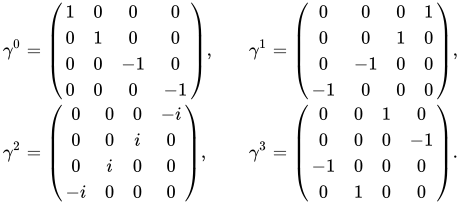
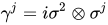
is the time-like, hermitian matrix. The other three are space-like, antihermitian matrices. More compactly, , and , where denotes the Kronecker product and the (for j = 1, 2, 3) denote the Pauli matrices.



The gamma matrices have a group structure, the gamma group, that is shared by all matrix representations of the group, in any dimension, for any signature of the metric. For example, the Pauli matrices are a set of "gamma" matrices in dimension 3 with metric of Euclidean signature (3, 0). In 5 spacetime dimensions, the 4 gammas above together with the fifth gamma-matrix to be presented below generate the Clifford algebra.
Mathematical structure
The defining property for the gamma matrices to generate a Clifford algebra is the anticommutation relation

where 


This defining property is more fundamental than the numerical values used in the specific representation of the gamma matrices. Covariant gamma matrices are defined by

and Einstein notation is assumed.
Note that the other sign convention for the metric, (− + + +) necessitates either a change in the defining equation:

or a multiplication of all gamma matrices by 

Physical structure
The Clifford algebra Cl1,3(ℝ) over spacetime V can be regarded as the set of real linear operators from V to itself, End(V), or more generally, when complexified to Cl1,3(ℝ)ℂ, as the set of linear operators from any 4-dimensional complex vector space to itself. More simply, given a basis for V, Cl1,3(ℝ)ℂ is just the set of all 4 × 4 complex matrices, but endowed with a Clifford algebra structure. Spacetime is assumed to be endowed with the Minkowski metric ημν. A space of bispinors, Ux, is also assumed at every point in spacetime, endowed with the bispinor representation of the Lorentz group. The bispinor fields Ψ of the Dirac equations, evaluated at any point x in spacetime, are elements of Ux, see below. The Clifford algebra is assumed to act on Ux as well (by matrix multiplication with column vectors Ψ(x) in Ux for all x). This will be the primary view of elements of Cl1,3(ℝ)ℂ in this section.
For each linear transformation S of Ux, there is a transformation of End(Ux) given by SES−1 for E in Cl1,3(ℝ)ℂ ≈ End(Ux). If S belongs to a representation of the Lorentz group, then the induced action E ↦ SES−1 will also belong to a representation of the Lorentz group, see Representation theory of the Lorentz group.
If S(Λ) is the bispinor representation acting on Ux of an arbitrary Lorentz transformation Λ in the standard (4-vector) representation acting on V, then there is a corresponding operator on End(Ux) = Cl1,3(ℝ)ℂ given by

showing that the γμ can be viewed as a basis of a representation space of the 4-vector representation of the Lorentz group sitting inside the Clifford algebra. The last identity can be recognized as the defining relationship for matrices belonging to an indefinite orthogonal group, which is 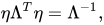

should be treated as 4-vectors in manipulations. It also means that indices can be raised and lowered on the γ using the metric ημν as with any 4-vector. The notation is called the Feynman slash notation. The slash operation maps the basis eμ of V, or any 4-dimensional vector space, to basis vectors γμ. The transformation rule for slashed quantities is simply
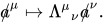
One should note that this is different from the transformation rule for the γμ, which are now treated as (fixed) basis vectors. The designation of the 4-tuple (γμ) = (γ0, γ1, γ2, γ3) as a 4-vector sometimes found in the literature is thus a slight misnomer. The latter transformation corresponds to an active transformation of the components of a slashed quantity in terms of the basis γμ, and the former to a passive transformation of the basis γμ itself.
The elements σμν = γμγν − γνγμ form a representation of the Lie algebra of the Lorentz group. This is a spin representation. When these matrices, and linear combinations of them, are exponentiated, they are bispinor representations of the Lorentz group, e.g., the S(Λ) of above are of this form. The 6-dimensional space the σμν span is the representation space of a tensor representation of the Lorentz group. For the higher order elements of the Clifford algebra in general and their transformation rules, see the article Dirac algebra. The spin representation of the Lorentz group is encoded in the spin group Spin(1, 3) (for real, uncharged spinors) and in the complexified spin group Spinc(1, 3) for charged (Dirac) spinors.
Expressing the Dirac equation
In natural units, the Dirac equation may be written as

where 
Switching to Feynman notation, the Dirac equation is

The fifth "gamma" matrix, γ5
It is useful to define a product of the four gamma matrices as 
(in the Dirac basis).
Although 


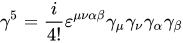
using the convention 
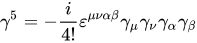
using the convention 
This can be seen by exploiting the fact that all the four gamma matrices anticommute, so
,
where 

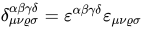

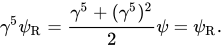
This matrix is useful in discussions of quantum mechanical chirality. For example, a Dirac field can be projected onto its left-handed and right-handed components by:
.
Some properties are:
- It is hermitian:
- Its eigenvalues are ±1, because:
- It anticommutes with the four gamma matrices:



In fact, 

, and
Five dimensions
The Clifford algebra in odd dimensions behaves like two copies of the Clifford algebra of one less dimension, a left copy and a right copy.[1] Thus, one can employ a bit of a trick to repurpose iγ5 as one of the generators of the Clifford algebra in five dimensions. In this case, the set {γ0, γ1, γ2, γ3, iγ5} therefore, by the last two properties (keeping in mind that i2 = −1) and those of the old gammas, forms the basis of the Clifford algebra in 5 spacetime dimensions for the metric signature (1,4).[2] In metric signature (4,1), the set {γ0, γ1, γ2, γ3, γ5} is used, where the γμ are the appropriate ones for the (3,1) signature.[3] This pattern is repeated for spacetime dimension 2n even and the next odd dimension 2n + 1 for all n ≥ 1.[4] For more detail, see Higher-dimensional gamma matrices.
Identities
The following identities follow from the fundamental anticommutation relation, so they hold in any basis (although the last one depends on the sign choice for
Miscellaneous identities
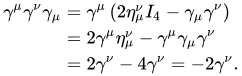
- Proof
Take the standard anticommutation relation:
One can make this situation look similar by using the metric
:
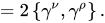
- Proof
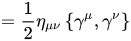
Similarly to the proof of 1, again beginning with the standard commutation relation:
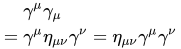
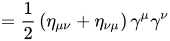
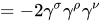
- Proof
To show
Use the anticommutator to shift
to the right
Using the relation
we can contract the last two gammas, and get
Finally using the anticommutator identity, we get
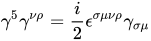
- Proof
- Proof
If
then
and it is easy to verify the identity. That is the case also when
,
or
.
On the other hand, if all three indices are different,
,
and
and both sides are completely antisymmetric; the left hand side because of the anticommutativity of the
matrices, and on the right hand side because of the antisymmetry of
. It thus suffices to verify the identities for the cases of
,
,
and
.






















Trace identities
The gamma matrices obey the following trace identities:
- Trace of any product of an odd number of
- Trace of






Proving the above involves the use of three main properties of the trace operator:
- tr(A + B) = tr(A) + tr(B)
- tr(rA) = r tr(A)
- tr(ABC) = tr(CAB) = tr(BCA)
From the definition of the gamma matrices,

We get
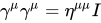
or equivalently,

where 

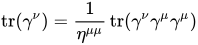
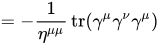

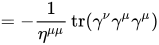

This implies

To show

First note that

We'll also use two facts about the fifth gamma matrix

So lets use these two facts to prove this identity for the first non-trivial case: the trace of three gamma matrices. Step one is to put in one pair of





This can only be fulfilled if

The extension to 2n+1 (n integer) gamma matrices, is found by placing two gamma-5s after (say) the 2n-th gamma-matrix in the trace, commuting one out to the right (giving a minus sign) and commuting the other gamma-5 2n steps out to the left [with sign change (-1)^2n =1 ]. Then we use cyclic identity to get the two gamma-5s together, and hence they square to identity, leaving us with the trace equalling minus itself, i.e. 0.
If an odd number of gamma matrices appear in a trace followed by
To show

Begin with,



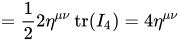
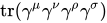


For the term on the right, we'll continue the pattern of swapping 



Again, for the term on the right swap
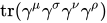


Eq (3) is the term on the right of eq (2), and eq (2) is the term on the right of eq (1). We'll also use identity number 3 to simplify terms like so:

So finally Eq (1), when you plug all this information in gives


The terms inside the trace can be cycled, so

So really (4) is

or

To show
,
begin with
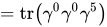

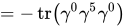
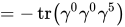

Add 
.
Now, this pattern can also be used to show
.
Simply add two factors of 


So,
For a proof of identity 6, the same trick still works unless 
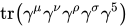




Denote the product of 






Conjugating with 


Normalization
The gamma matrices can be chosen with extra hermiticity conditions which are restricted by the above anticommutation relations however. We can impose
, compatible with

and for the other gamma matrices (for k = 1, 2, 3)
, compatible with
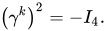
One checks immediately that these hermiticity relations hold for the Dirac representation.
The above conditions can be combined in the relation
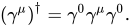
The hermiticity conditions are not invariant under the action 


Charge conjugation
The charge conjugation operator, in any basis, may be defined as

where 

Representation-independent identities include:
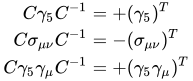
In addition, for all four representations given below (Dirac, Majorana and both chiral variants), one has

Feynman slash notation used in quantum field theory
The Feynman slash notation is defined by

for any 4-vector a.
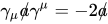
Here are some similar identities to the ones above, but involving slash notation:
- where
is the Levi-Civita symbol and
Actually traces of products of odd number of
- where
[5]



![{\displaystyle \operatorname {tr} \left({a\!\!\!/}{b\!\!\!/}{c\!\!\!/}{d\!\!\!/}\right)=4\left[(a\cdot b)(c\cdot d)-(a\cdot c)(b\cdot d)+(a\cdot d)(b\cdot c)\right]}](https://wikimedia.org/api/rest_v1/media/math/render/svg/56c57a7d1c73aea6e330e803d9ac401224d8a0d3)




Other representations
The matrices are also sometimes written using the 2×2 identity matrix, 
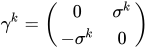
where k runs from 1 to 3 and the σk are Pauli matrices.
Dirac basis
The gamma matrices we have written so far are appropriate for acting on Dirac spinors written in the Dirac basis; in fact, the Dirac basis is defined by these matrices. To summarize, in the Dirac basis:

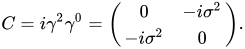
In the Dirac basis, the charge conjugation operator is[6]
Weyl (chiral) basis
Another common choice is the Weyl or chiral basis, in which 

or in more compact notation:

The Weyl basis has the advantage that its chiral projections take a simple form,

The idempotence of the chiral projections is manifest. By slightly abusing the notation and reusing the symbols 

where now
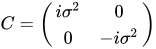
The charge conjugation operator in this basis is
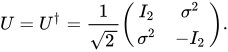
The Dirac basis can be obtained from the Weyl basis as

via the unitary transform

Weyl (chiral) basis (alternate form)
Another possible choice[6][7] of the Weyl basis has

The chiral projections take a slightly different form from the other Weyl choice,

In other words,

where
The charge conjugation operator in this basis is

This basis can be obtained from the Dirac basis above as 

Majorana basis
There is also the Majorana basis, in which all of the Dirac matrices are imaginary, and the spinors and Dirac equation are real. Regarding the Pauli matrices, the basis can be written as[6]

where
(The reason for making all gamma matrices imaginary is solely to obtain the particle physics metric (+, −, −, −), in which squared masses are positive. The Majorana representation, however, is real. One can factor out the i to obtain a different representation with four component real spinors and real gamma matrices. The consequence of removing the
The Majorana basis can be obtained from the Dirac basis above as 
Cℓ1,3(C) and Cℓ1,3(R)
The Dirac algebra can be regarded as a complexification of the real algebra Cℓ1,3(R), called the space time algebra:

Cℓ1,3(R) differs from Cℓ1,3(C): in Cℓ1,3(R) only real linear combinations of the gamma matrices and their products are allowed.
Two things deserve to be pointed out. As Clifford algebras, Cℓ1,3(C) and Cℓ4(C) are isomorphic, see classification of Clifford algebras. The reason is that the underlying signature of the spacetime metric loses its signature (1,3) upon passing to the complexification. However, the transformation required to bring the bilinear form to the complex canonical form is not a Lorentz transformation and hence not "permissible" (at the very least impractical) since all physics is tightly knit to the Lorentz symmetry and it is preferable to keep it manifest.
Proponents of geometric algebra strive to work with real algebras wherever that is possible. They argue that it is generally possible (and usually enlightening) to identify the presence of an imaginary unit in a physical equation. Such units arise from one of the many quantities in a real Clifford algebra that square to −1, and these have geometric significance because of the properties of the algebra and the interaction of its various subspaces. Some of these proponents also question whether it is necessary or even useful to introduce an additional imaginary unit in the context of the Dirac equation.[8]
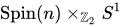
In the mathematics of Riemannian geometry, it is conventional to define the Clifford algebra Cℓp,q(ℝ) for arbitrary dimensions p,q; the anti-commutation of the Weyl spinors emerges naturally from the Clifford algebra.[9] The Weyl spinors transform under the action of the spin group 






Insofar as the presentation of charge and parity can be a confusing topic in conventional quantum field theory textbooks, the more careful dissection of these topics in a general geometric setting can be elucidating. Standard expositions of the Clifford algebra construct the Weyl spinors from first principles; that they "automatically" anti-commute is an elegant geometric by-product of the construction, completely by-passing any arguments that appeal to the Pauli exclusion principle (or the sometimes common sensation that Grassmann variables have been introduced via ad hoc argumentation.)
However, in contemporary practice in physics, the Dirac algebra rather than the space-time algebra continues to be the standard environment the spinors of the Dirac equation "live" in.
Euclidean Dirac matrices
In quantum field theory one can Wick rotate the time axis to transit from Minkowski space to Euclidean space. This is particularly useful in some renormalization procedures as well as lattice gauge theory. In Euclidean space, there are two commonly used representations of Dirac matrices:
Chiral representation

Notice that the factors of

will emerge. It is also worth noting that there are variants of this which insert instead 
In Euclidean space,

Using the anti-commutator and noting that in Euclidean space 

In chiral basis in Euclidean space,
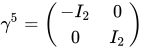
which is unchanged from its Minkowski version.
Non-relativistic representation
This article uses material from the Wikipedia article
Metasyntactic variable, which is released under the
Creative Commons
Attribution-ShareAlike 3.0 Unported License.
